

Ensure Success With Updated Verified NCA-6.10 Exam Dumps [2026]
Exam Materials for You to Prepare & Pass NCA-6.10 Exam.
NEW QUESTION # 43
An administrator needs to license a new AOS-based cluster with no add-on packages via Nutanix Cloud Platform Package Licensing.
What license type would fulfill this requirement?
- A. Nutanix Unified Storage (NUS)
- B. Nutanix Cloud Infrastructure (NCI)
- C. Nutanix Database Service (NDB)
- D. Nutanix Cloud Manager (NCM)
Answer: B
Explanation:
To license a new AOS-based cluster with no add-on packages, the appropriate license type isNutanix Cloud Infrastructure (NCI). The NCI license provides the fundamental capabilities required for Nutanix clusters, including:
* Storage and data management.
* Core virtualization features.
* Compute resources for workloads.
NCI is designed for organizations that need the essential features of the Nutanix platform without additional add-ons such as database services (NDB) or advanced storage options (NUS).
Other options:
* A. Nutanix Cloud Manager (NCM):Focuses on management capabilities for multi-cloud and operational tasks, not core infrastructure licensing.
* C. Nutanix Unified Storage (NUS):Specifically provides unified file and object storage capabilities, not relevant for a base AOS cluster.
* D. Nutanix Database Service (NDB):A dedicated licensing tier for database management features.
References:
Nutanix Licensing Overview
Nutanix Support Documentation - Licensing Models.
NEW QUESTION # 44
An administrator receives the alert:
What is the most likely cause?
- A. Other nodes in the cluster may not have enough resource available.
- B. This node in the cluster may not have enough resources available.
- C. This node in the cluster is already in maintenance mode.
- D. Another node in this cluster is already in maintenance mode.
Answer: A
Explanation:
When a Nutanix cluster alert occurs, indicating maintenance mode issues, the most likely cause is that another node in the cluster is already in maintenance mode. Nutanix clusters enforce restrictions to prevent more than one node from entering maintenance mode simultaneously. This ensures the cluster can maintain resiliency and availability, adhering to the redundancy factor (RF) policy.
If another node is already in maintenance mode, the cluster cannot afford to have additional nodes enter maintenance without compromising data and service availability.
:
Nutanix Cluster Best Practices Documentation - Maintenance Mode.
Nutanix Alerts and Events Guide, accessible via Prism UI.
NEW QUESTION # 45
At what time does LCM auto-inventory run by default?
- A. 1:00am
- B. 3:00am
- C. 2:00am
- D. 4:00am
Answer: C
Explanation:
By default, Nutanix Lifecycle Manager (LCM) auto-inventory runs at2:00 AMlocal cluster time. LCM performs a daily check to gather information about available updates for firmware, software, and other components to ensure the cluster remains up-to-date. This operation is non-disruptive and does not impact cluster performance.
:
Nutanix Lifecycle Manager (LCM) Documentation - Default Settings.
Nutanix Support Portal - LCM FAQ.
NEW QUESTION # 46
On a newly-deployed AHV cluster, what is the default virtual switch (vs0) uplink bond type?
- A. No Uplink Bond
- B. Balance-TCP
- C. Balance-SLB
- D. Active-Backup
Answer: D
Explanation:
On a newly deployed AHV cluster, the default uplink bond type for the virtual switch (vs0) isBalance-SLB (Source Load Balancing). This configuration balances traffic across the uplink interfaces based on the source of the traffic, ensuring optimal usage of available network bandwidth without requiring LACP configuration on the physical switches.
:
Nutanix AHV Networking Guide - Default Uplink Bond Types.
Nutanix Networking Best Practices for AHV Clusters.
NEW QUESTION # 47
Refer to the exhibit.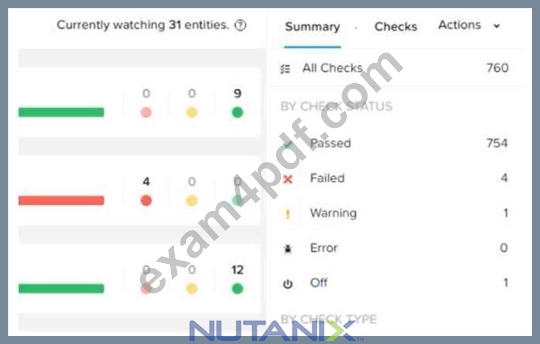
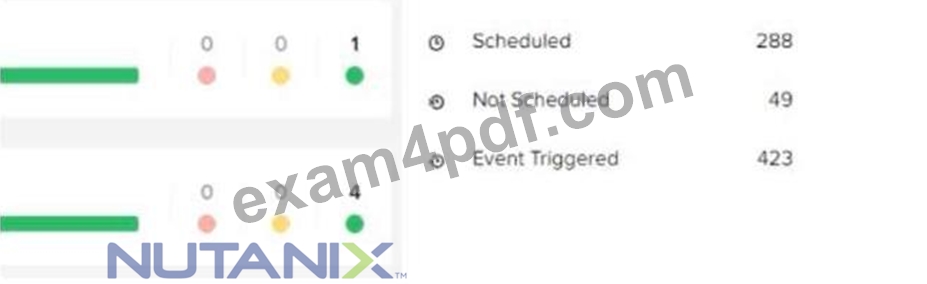
What should be first selected to run a full health check?
- A. Actions
- B. Checks
- C. Failed
- D. Scheduled
Answer: B
NEW QUESTION # 48
When multiple Alert policies are applied to an entity, which will take precedence?
- A. Policy are applied to all entities of an entity type.
- B. Policy are applied to an entity type in a cluster.
- C. Policy are applied to an entity type in a category.
- D. Policy are applied to a specific entity type.
Answer: D
Explanation:
When multiple alert policies are applied to an entity, Nutanix uses a hierarchical approach. Policies applied to an entity type within a categorytake precedence. For example:
* If a category (e.g., "Production") has policies applied to entities like VMs, and the entity matches that category, the category-specific policy will override general policies.
* This prioritization allows administrators to fine-tune alert policies for specific workloads or environments.
:
Nutanix Alerts Management Guide - Policy Precedence Overview.
Nutanix University Certification Training Material.
NEW QUESTION # 49
An administrator needs to enable Self Service Restore (SSR) on a Nutanix-hosted VM.
What is required for the administrator to complete this task?
- A. VMWare Tools
- B. A Storage Container
- C. Nutanix Guest Tools
- D. Prism Central
Answer: C
NEW QUESTION # 50
An administrator needs to ensure that the three VMs of an application cluster are never placed onto the same hypervisor by creating a VM- VM Anti-Affinity Policy.
What should the administrator use to complete this task?
- A. Ncli
- B. acli
- C. Prism Central
- D. Prism Element
Answer: C
Explanation:
To create a VM-VM Anti-Affinity Policy ensuring VMs are not placed on the same hypervisor,Prism Central is required. Anti-affinity policies are cluster-wide configurations managed through Prism Central's policy- based interface, enabling placement rules to distribute workloads effectively.
Steps:
* Navigate toPrism Central > Policies.
* Create a new Anti-Affinity Policy.
* Select the VMs and configure the policy to ensure separation.
References:
Nutanix Prism Central Guide - Policy Management.
Nutanix Best Practices for VM Placement Policies.
NEW QUESTION # 51
What is the minimum cluster size for Redundancy Factor 3?
- A. 6 nodes
- B. 5 nodes
- C. 4 nodes
- D. 3 nodes
Answer: B
Explanation:
https://portal.nutanix.com/page/documents/details?targetId=Web-Console-Guide-Prism-v5_20:arc-redundancy-factor3-c.html
NEW QUESTION # 52
An administrator is performing AHV upgrades on an 8-node cluster configured with Redundancy Factor 3.
How many nodes would be placed into maintenance mode simultaneously?
- A. 0
- B. 1
- C. 2
- D. 3
Answer: B
NEW QUESTION # 53
Which Nutanix Support case priority level indicates that the system is available but experiencing issues that directly impact productivity?
- A. P2
- B. P3
- C. P1
- D. P4
Answer: A
Explanation:
Nutanix Support case priority levels are defined as follows:
* P1 (Critical):The system is down or severely impacted, requiring immediate attention.
* P2 (High):The system is available but experiencing issues that directly impact productivity or operations.
* P3 (Medium):The system is functioning, but there are non-critical issues or questions.
* P4 (Low):General questions or requests that do not impact system performance.
The scenario described matchesP2, where the system is available but productivity is directly affected by the issue.
References:
Nutanix Support Policy Documentation.
Nutanix Knowledge Base Article on Support Case Priorities.
NEW QUESTION # 54
Within Prism Central, which Compute and Storage section will allow an administrator to upload a Windows ISO file?
- A. Templates
- B. Images
- C. OVAS
- D. Calatog Items
Answer: B
NEW QUESTION # 55
Which hypervisor supports integrated IP address management (IPAM)?
- A. Hyper-V
- B. AHV
- C. ESXi
- D. XenServer
Answer: B
Explanation:
Nutanix AHV (Acropolis Hypervisor) supports integrated IP address management (IPAM) as a built-in feature. IPAM allows administrators to dynamically allocate and manage IP addresses for VMs within a network segment. This functionality simplifies network management by automating the assignment of IPs without relying on external DHCP servers.
* A. ESXi:Incorrect, as ESXi does not include built-in IPAM.
* B. Hyper-V:Incorrect, as Hyper-V lacks integrated IPAM functionality.
* C. AHV:Correct, as AHV has built-in IPAM for automated IP address allocation.
* D. XenServer:Incorrect, as XenServer does not support integrated IPAM.
References:
Nutanix AHV Networking Guide: IPAM Configuration.
Nutanix University: AHV Networking Module.
NEW QUESTION # 56
When configuring a physical network switch in Prism Element, what information is required?
- A. NTP Configuration
- B. SMTP Configuration
- C. SNMP Configuration
- D. DNS Configuration
Answer: C
Explanation:
When configuring a physical network switch in Prism Element,SNMP Configurationis required to enable monitoring and communication between the Nutanix cluster and the network switch. SNMP (Simple Network Management Protocol) is used to gather metrics and detect issues such as link failures or performance bottlenecks, ensuring the cluster operates efficiently with the physical network infrastructure.
:
Nutanix Network Management Guide - SNMP Configuration.
Nutanix Administration Guide - Configuring Switches for Monitoring
NEW QUESTION # 57 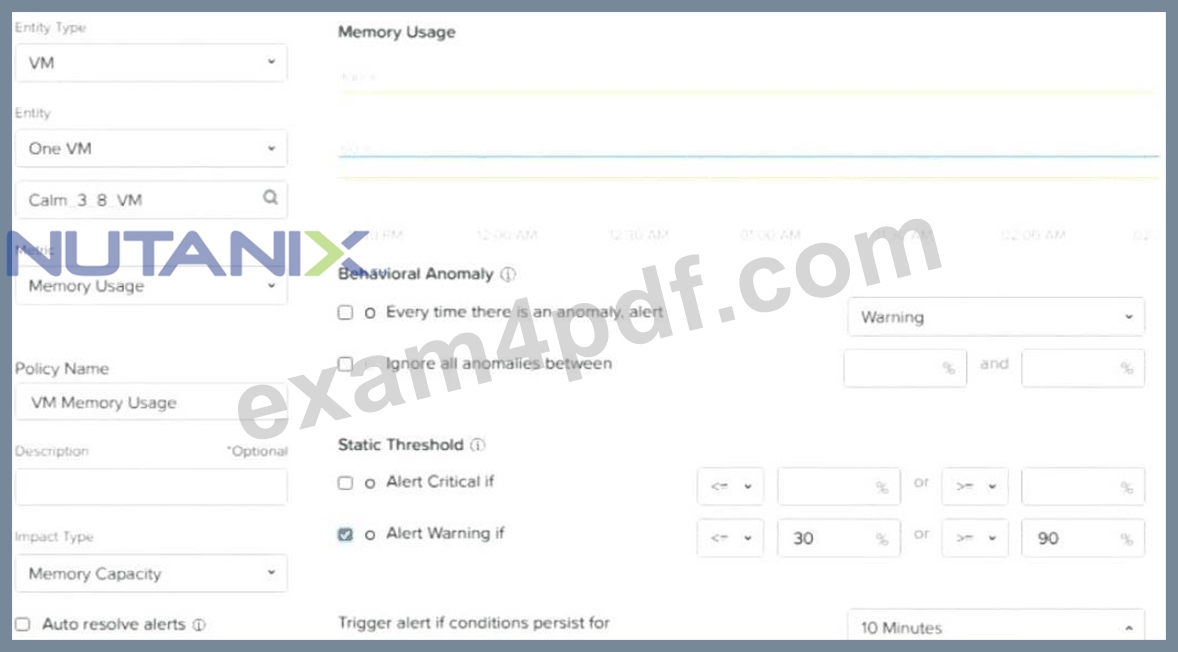
A custom alert policy is configured for a VM named Calm_3_8_VM to generate aWarningalert ifmemory usageexceeds90%or is below30%for10 minutes.
What action can be taken to prevent this alert policy from creating multiple alerts within a 48-hour period if the 90% threshold is crossed multiple times?
- A. Select highest value in Trigger alert if conditions persist for.
- B. After alert occurs, uncheck Enable Policy box for 48 hours.
- C. Select the Auto resolve alerts checkbox and click Save.
- D. Set Ignore all anomalies between to 90% and 100%.
Answer: C
Explanation:
The correct answer isA. Select the Auto resolve alerts checkbox and click Save.
When an alert policy is configured based on astatic threshold, it will generate an alert each time the condition is met unless it has beenauto-resolvedor manually acknowledged. By enablingAuto resolve alerts, the system willautomatically clear the alertonce the metric falls back within the acceptable range. This preventsduplicate alertswhen the threshold is exceeded repeatedly within a short timeframe (e.g., multiple times over 48 hours).
Explanation of Incorrect Options:
* B (Disable policy):Not scalable or operationally sound.
* C (Ignore anomalies):Applies only to behavioral anomalies, not static thresholds.
* D (Trigger duration):Increases delay before alerting but does not suppress repeated alerts.
UI Location in Image:
#"Auto resolve alerts" is visible just below "Impact Type."
Official Reference:
* Nutanix Prism Central Guide - Alert Policies
* Excerpt: "Enable 'Auto resolve alerts' to ensure alerts are cleared automatically once conditions normalize, avoiding duplicate alerts."
NEW QUESTION # 58
At what time does LCM auto-inventory run by default?
- A. 1:00am
- B. 2:00am
- C. 3:00am
- D. 4:00am
Answer: C
NEW QUESTION # 59
Shared storage for Windows Server Failover Clustering (WSFC) is a use case for which Nutanix Unified Storage solution?
- A. FT1
- B. Files
- C. RF2
- D. Volumes
Answer: D
Explanation:
Shared storage for Windows Server Failover Clustering (WSFC) is a use case for NutanixVolumes. Nutanix Volumes provides block storage (via iSCSI) to external systems, such as WSFC nodes, allowing them to share storage for failover clustering. This configuration is essential for high availability in Windows environments.
Other options:
* Files: Provides file-based storage (NFS/SMB), not suited for WSFC shared block storage.
* FT1 and RF2: Refer to Fault Tolerance and Redundancy Factor, not storage solutions.
:
Nutanix Unified Storage Guide - Volumes Use Cases.
Nutanix Best Practices for Windows Clustering.
NEW QUESTION # 60
An administrator is using LCM at a connected site to update various components on a Nutanix cluster and notices that the LCM Framework is not updated to the current version.
What step should the administrator take to ensure LCM is updated to the latest release?
- A. Upgrade AOS
- B. Perform an inventory.
- C. Restart genesis across the cluster.
- D. Run an NCC health check.
Answer: B
Explanation:
The correct answer isC. Perform an inventory.
To ensure theLCM Frameworkand its associated component metadata are updated, the administrator must perform afresh LCM inventory. This process:
* Retrieves the latest metadata and framework version from the Nutanix support portal (if the cluster is connected).
* Detects current component versions and identifies available updates.
Clarifications:
* A (Upgrade AOS):LCM is independent of AOS version updates.
* B (Restart genesis):Unnecessary and not relevant to LCM framework versioning.
* D (NCC):Useful for cluster health, but does not affect LCM updates.
Prism Central UI Navigation Path:
Operations > LCM > Perform Inventory
Official Reference:
* Nutanix LCM Guide - Updating the LCM Framework
* Excerpt: "To receive the latest framework version and component metadata, perform an LCM inventory on a connected cluster."
NEW QUESTION # 61
An administrator needs to license a new AOS-based cluster with no add-on packages via Nutanix Cloud Platform Package Licensing.
What license type would fulfill this requirement?
- A. Nutanix Unified Storage (NUS)
- B. Nutanix Cloud Infrastructure (NCI)
- C. Nutanix Database Service (NDB)
- D. Nutanix Cloud Manager (NCM)
Answer: B
NEW QUESTION # 62
After starting LCM updates, an administrator would like to see a detailed view of each update as it progresses.
Which Prism Element dashboard should the administrator use to monitor the LCM updates?
- A. Alerts
- B. Tasks
- C. Hardware
- D. Analysis
Answer: B
Explanation:
TheTasksdashboard in Prism Element provides detailed visibility into the progress of all ongoing and completed tasks, including Life Cycle Manager (LCM) updates. Administrators can monitor the step-by-step status of LCM operations, track failures, and identify bottlenecks.
* A. Analysis:Incorrect, as this is used for performance monitoring, not task progress.
* B. Tasks:Correct, as it displays detailed progress for updates and other operations.
* C. Hardware:Incorrect, as this focuses on the state and configuration of hardware components.
* D. Alerts:Incorrect, as this shows system alerts and issues, not detailed task progress.
References:
Nutanix Life Cycle Manager Guide: Monitoring Updates.
Prism Element Administration Guide: Tasks Dashboard.
NEW QUESTION # 63
An administrator needs to create a VM Template from an existing VM.
What is required for this action to be successful?
- A. The VM is powered on.
- B. Windows OS is installed.
- C. Sysprep or Cloud-init script.
- D. The VM is powered off.
Answer: D
Explanation:
To create a VM template from an existing VM in Nutanix, the VM must be powered off. This ensures that the template is consistent and does not include any transient data or activity from the VM. Once the VM is powered off, the administrator can use the Prism UI to take a snapshot and designate it as a template.
* A. Sysprep or Cloud-init script:These are optional for post-deployment configuration, not mandatory for creating a template.
* B. The VM is powered on:This is incorrect, as the VM must be powered off.
* C. Windows OS is installed:The OS type is irrelevant for creating a template.
* D. The VM is powered off:Correct, as creating a template requires the VM to be in a powered-off state.
References:
Nutanix AHV Administration Guide: Nutanix Documentation
Nutanix University Certification Content for NCP and NCM.
NEW QUESTION # 64
An administrator is conducting updates in a Nutanix cluster and is being prompted for handling non-migratable VMs.
Which VM type is non-migratable?
- A. VMs without NGT
- B. Memory Overcommitted
- C. VMs marked as an Agent
- D. VMs O VMs with attached Volume Groups
Answer: D
NEW QUESTION # 65
......
Updated NCA-6.10 Certification Exam Sample Questions: https://dumpstorrent.exam4pdf.com/NCA-6.10-dumps-torrent.html
