

2025 Updated Verified N10-009 dumps Q&As - 100% Pass Guaranteed
Provide Valid Dumps To Help You Prepare For CompTIA Network+ Certification Exam Exam
CompTIA N10-009 Exam Syllabus Topics:
| Topic | Details |
|---|---|
| Topic 1 |
|
| Topic 2 |
|
| Topic 3 |
|
| Topic 4 |
|
NEW QUESTION # 93
A newtwork administrator needs to create an SVI on a Layer 3-capable device to separate voice and data traffic. Which of the following best explains this use case?
- A. A physical interface used for trunking logical ports
- B. A physical interface used for management access
- C. A logical interface used for the routing of VLANs
- D. A logical interface used when the number of physical ports is insufficent.
Answer: C
Explanation:
An SVI (Switched Virtual Interface) is a logical interface on a Layer 3-capable switch used to route traffic between VLANs. This is particularly useful in environments where voice and data traffic need to be separated, as each type of traffic can be assigned to different VLANs and routed accordingly.
SVI (Switched Virtual Interface): A virtual interface created on a switch for inter-VLAN routing.
VLAN Routing: Enables the routing of traffic between VLANs on a Layer 3 switch, allowing for logical separation of different types of traffic, such as voice and data.
Use Case: Commonly used in scenarios where efficient and segmented traffic management is required, such as in VoIP implementations.
NEW QUESTION # 94
A network administrator needs to connect a department to a new network segment. They need to use a DHCP server located on another network. Which of the following can the administrator use to complete this task?
- A. IP Helper
- B. Exclusion
- C. Scope
- D. Reservation
Answer: A
Explanation:
Comprehensive and Detailed In-Depth Explanation:
An IP Helper (IP Helper Address) allows DHCP requests to pass through routers and reach a DHCP server on another network.
* DHCP broadcasts are not forwarded across routers by default, so an IP Helper Address is needed to relay the request.
* This is crucial for large networks where a single DHCP server serves multiple subnets.
* Option B (Reservation): Ensures a specific IP address is assigned to a MAC address but does not relay DHCP across networks.
* Option C (Exclusion): Prevents specific IP addresses from being assigned, but does not help with DHCP relay.
* Option D (Scope): Defines the range of IP addresses available for DHCP clients but does not assist in cross-network communication.
? Reference: CompTIA Network+ (N10-009) Official Study Guide - Section: DHCP and IP Addressing
NEW QUESTION # 95
A network administrator is planning to host a company application in the cloud, making the application available for all internal and third-party users. Which of the following concepts describes this arrangement?
- A. Multitenancy
- B. VPC
- C. NFV
- D. SaaS
Answer: A
Explanation:
Multitenancy is a cloud computing architecture where a single instance of software serves multiple customers or tenants. Each tenant's data is isolated and remains invisible to other tenants. Hosting a company application in the cloud to be available for both internal and third-party users fits this concept, as it allows shared resources and infrastructure while maintaining data separation and security. Reference: CompTIA Network+ Exam Objectives and official study guides.
NEW QUESTION # 96
Which of the following network cables involves bounding light off of protective cladding?
- A. Single-mode
- B. Twinaxial
- C. Multimode
- D. Coaxial
Answer: C
Explanation:
Multimode fiber optic cables involve the transmission of light signals that bounce off the core's cladding as they travel down the fiber. This characteristic differentiates it from single-mode fiber, where the light travels directly down the fiber without reflecting off the cladding.
Here are some detailed points about multimode fiber cables:
Construction: Multimode fibers have a larger core diameter, typically 50 or 62.5 microns, compared to single-mode fibers, which have a core diameter of about 9 microns.
Light Propagation: The larger core of multimode fiber allows multiple light modes to propagate. These modes travel at different angles, leading to reflections off the core-cladding boundary.
Distance and Bandwidth: Due to modal dispersion, where different light modes arrive at the receiver at different times, multimode fibers are suited for shorter distance applications compared to single-mode fibers. Typical distances are up to 550 meters for 10 Gbps Ethernet using OM4 multimode fiber.
Applications: Multimode fibers are commonly used in LANs (Local Area Networks), data centers, and for shorter distance data transmission due to their cost-effectiveness and ease of installation.
Network Reference:
CompTIA Network+ N10-007 Official Certification Guide, which covers fiber optic technologies, including the differences between multimode and single-mode fibers.
Cisco Networking Academy: Provides training materials and reference guides on the properties of different fiber optic cables.
Fiber Optic Association (FOA): A professional society dedicated to fiber optics, offering extensive information and certification on fiber optic technologies.
Multimode fibers are specifically designed for short-range communication with higher data rates and are typically used in environments like data centers, where high bandwidth over shorter distances is crucial. The reflections off the cladding, inherent to multimode fiber, facilitate this high-capacity communication.
NEW QUESTION # 97
A network technician needs to install patch cords from the UTP patch panel to the access switch for a newly occupied set of offices. The patch panel is not labeled for easy jack identification. Which of the following tools provides the easiest way to identify the appropriate patch panel port?
- A. Cable tester
- B. Toner
- C. Visual fault locator
- D. Laptop
Answer: B
Explanation:
A toner probe, often referred to as a toner and probe kit, is the easiest and most effective tool for identifying individual cables in a bundle, especially in situations where the patch panel is not labeled. The toner sends an audible tone through the cable, and the probe detects the tone at the other end, allowing the technician to quickly identify the correct cable.
Functionality: The toner generates a tone that travels along the cable. When the probe is placed near the correct cable, it detects the tone and emits a sound.
Ease of Use: Toner probes are straightforward to use, even in environments with many cables, making them ideal for identifying cables in unlabeled patch panels.
Efficiency: This method is much faster and more reliable than manual tracing, especially in complex setups.
Network Reference:
CompTIA Network+ N10-007 Official Certification Guide: Details tools used for cable identification and troubleshooting.
Cisco Networking Academy: Provides training on using toner probes and other cable testing tools.
Network+ Certification All-in-One Exam Guide: Explains the use of different tools for network cable identification and management.
NEW QUESTION # 98
A network administrator notices interference with industrial equipment in the 2.4GHz range. Which of the following technologies would most likely mitigate this issue? (Select two).
- A. Non-overlapping channel
- B. Captive portal
- C. Ad hoc network
- D. 5GHz frequency
- E. Omnidirectional antenna
- F. Mesh network
Answer: D
Explanation:
* Understanding 2.4GHz Interference:
* The 2.4GHz frequency range is commonly used by many devices, including Wi-Fi, Bluetooth, and various industrial equipment. This can lead to interference and degraded performance.
* Mitigation Strategies:
* 5GHz Frequency:
* The 5GHz frequency band offers more channels and less interference compared to the
2.4GHz band. Devices operating on 5GHz are less likely to encounter interference from other devices, including industrial equipment.
* Non-overlapping Channels:
* In the 2.4GHz band, using non-overlapping channels (such as channels 1, 6, and 11) can help reduce interference. Non-overlapping channels do not interfere with each other, providing clearer communication paths for Wi-Fi signals.
* Why Other Options are Less Effective:
* Mesh Network:While useful for extending network coverage, a mesh network does not inherently address interference issues.
* Omnidirectional Antenna:This type of antenna broadcasts signals in all directions but does not mitigate interference.
* Captive Portal:A web page that users must view and interact with before accessing a network, unrelated to frequency interference.
* Ad Hoc Network:A decentralized wireless network that does not address interference issues directly.
* Implementation:
* Switch Wi-Fi devices to the 5GHz band if supported by the network infrastructure and client devices.
* Configure Wi-Fi access points to use non-overlapping channels within the 2.4GHz band to minimize interference.
References:
* CompTIA Network+ study materials on wireless networking and interference mitigation.
NEW QUESTION # 99
SIMULATION
A network technician needs to resolve some issues with a customer's SOHO network.
The customer reports that some of the devices are not connecting to the network, while others appear to work as intended.
INSTRUCTIONS
Troubleshoot all the network components and review the cable test results by Clicking on each device and cable.
Diagnose the appropriate component(s) by identifying any components with a problem and recommend a solution to correct each problem.
Cable Test Results:
Cable 1: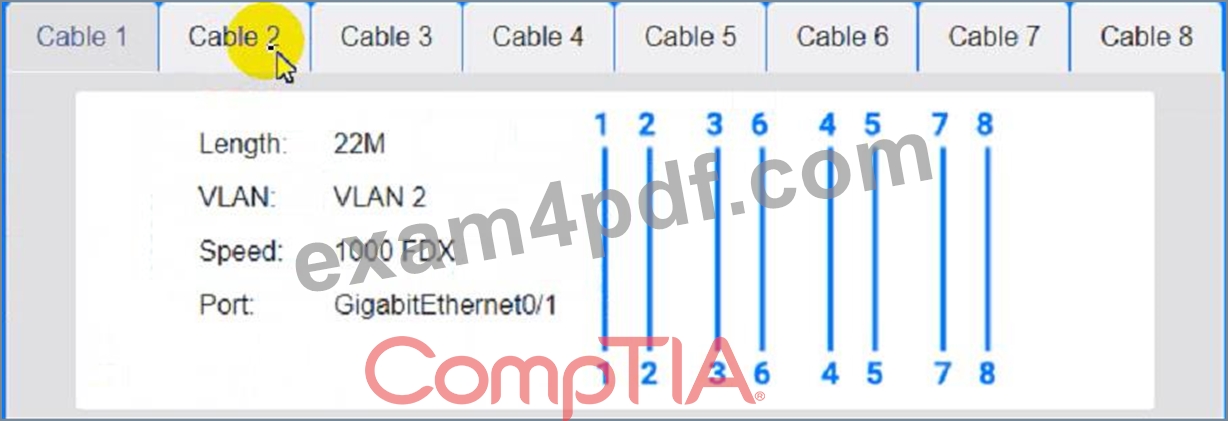
Cable 2:
Cable 3:
Cable 4:
Answer:
Explanation:
See the Explanation for detailed information on this simulation
Explanation:
(Note: Ips will be change on each simulation task, so we have given example answer for the understanding) To troubleshoot all the network components and review the cable test results, you can use the following steps:
Click on each device and cable to open its information window.
Review the information and identify any problems or errors that may affect the network connectivity or performance.
Diagnose the appropriate component(s) by identifying any components with a problem and recommend a solution to correct each problem.
Fill in the remediation form using the drop-down menus provided.
Here is an example of how to fill in the remediation form for PC1:
The component with a problem is PC1.
The problem is Incorrect IP address.
The solution is Change the IP address to 192.168.1.10.
You can use the same steps to fill in the remediation form for other components.
To enter commands in each device, you can use the following steps:
Click on the device to open its terminal window.
Enter the command ipconfig /all to display the IP configuration of the device, including its IP address, subnet mask, default gateway, and DNS servers.
Enter the command ping <IP address> to test the connectivity and reachability to another device on the network by sending and receiving echo packets. Replace <IP address> with the IP address of the destination device, such as 192.168.1.1 for Core Switch 1.
Enter the command tracert <IP address> to trace the route and measure the latency of packets from the device to another device on the network by sending and receiving packets with increasing TTL values. Replace <IP address> with the IP address of the destination device, such as 192.168.1.1 for Core Switch 1.
Here is an example of how to enter commands in PC1:
Click on PC1 to open its terminal window.
Enter the command ipconfig /all to display the IP configuration of PC1. You should see that PC1 has an incorrect IP address of 192.168.2.10, which belongs to VLAN 2 instead of VLAN 1.
Enter the command ping 192.168.1.1 to test the connectivity to Core Switch 1. You should see that PC1 is unable to ping Core Switch 1 because they are on different subnets.
Enter the command tracert 192.168.1.1 to trace the route to Core Switch 1. You should see that PC1 is unable to reach Core Switch 1 because there is no route between them.
You can use the same steps to enter commands in other devices, such as PC3, PC4, PC5, and Server 1.
NEW QUESTION # 100
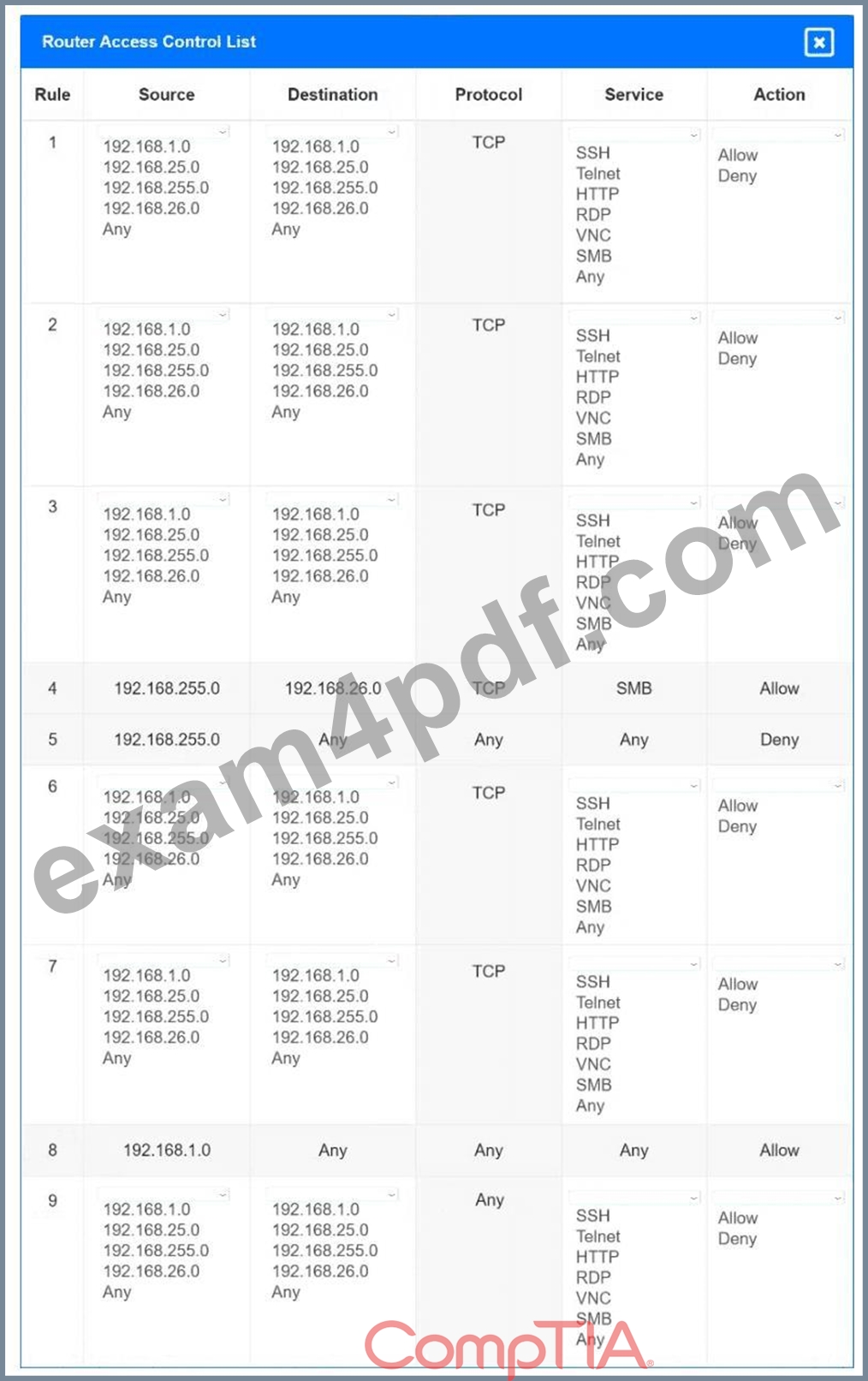
You have been tasked with implementing an ACL on the router that will:
1. Permit the most commonly used secure remote access technologies from the management network to all other local network segments
2. Ensure the user subnet cannot use the most commonly used remote access technologies in the Linux and Windows Server segments.
3. Prohibit any traffic that has not been specifically allowed.
INSTRUCTIONS
Use the drop-downs to complete the ACL
If at any time you would like to bring back the initial state of the simulation, please click the Reset All button.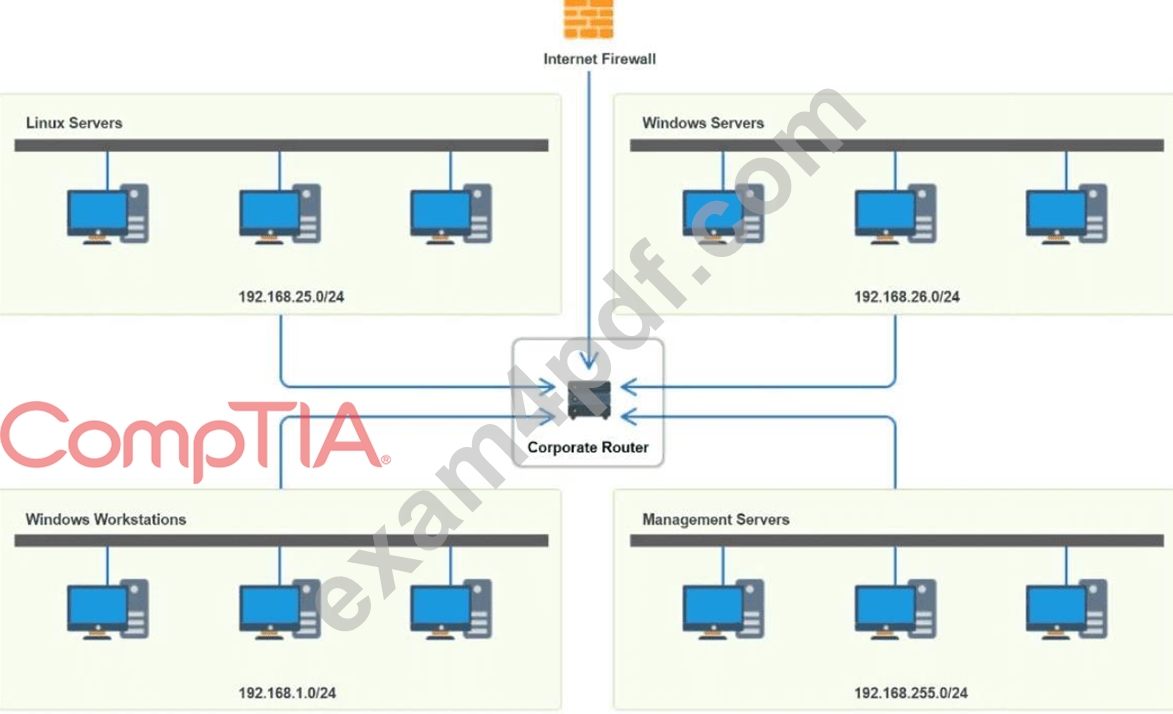
Answer:
Explanation:
See the answer and solution below.
Explanation:
A screenshot of a computer screen AI-generated content may be incorrect.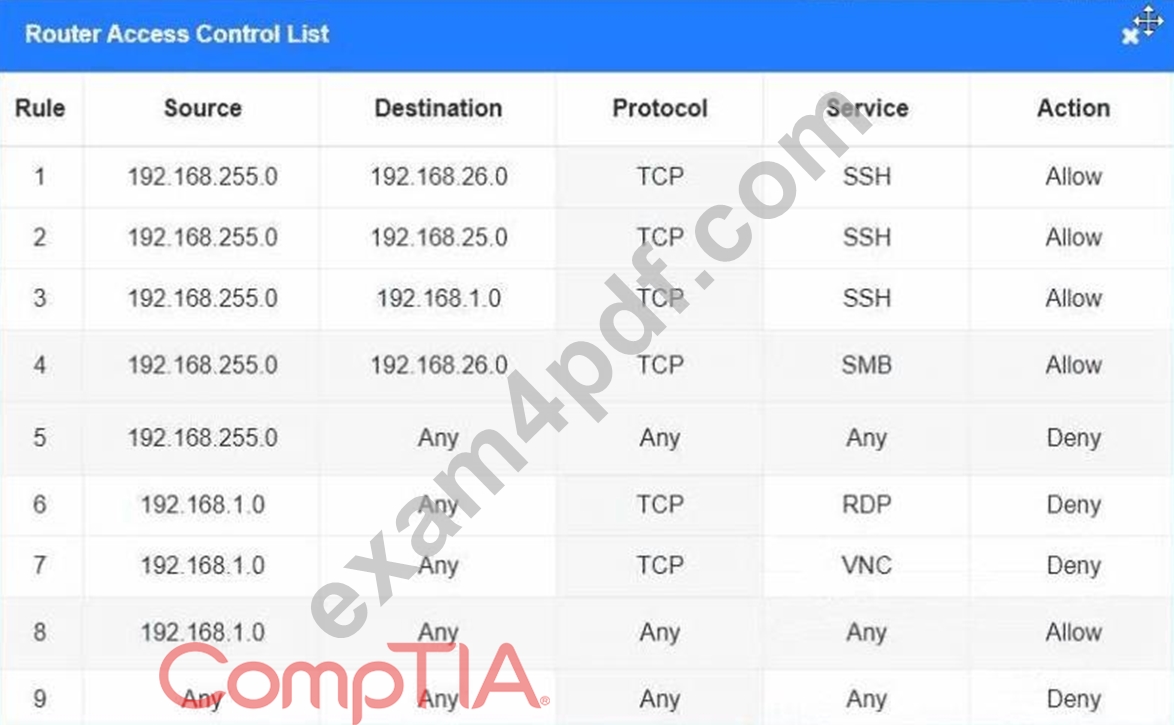
NEW QUESTION # 101
Which of the following kinds of targeted attacks uses multiple computers or bots to request the same resource repeatedly?
- A. MAC flooding
- B. DDoS
- C. ARP spoofing
- D. On-path
Answer: B
Explanation:
A Distributed Denial of Service (DDoS) attack leverages multiple computers or bots (botnet) to flood a target system with requests, overwhelming its resources and making it unavailable to legitimate users. This is a common tactic used by attackers to disrupt services. The document explains:
"A DDoS (Distributed Denial of Service) attack involves multiple computers (often called bots) simultaneously sending requests to a single resource, overwhelming the system and causing a denial of service to legitimate users."
NEW QUESTION # 102
A help desk technician receives a report that users cannot access internet URLs. The technician performs ping tests and finds that sites fail when a URL is used but succeed when an IP is used. Which of the following tools should the technician utilize next?
- A. dig
- B. tracert
- C. tcpdump
- D. nmap
Answer: A
Explanation:
The issue is clearly related toDNS resolution, as IP-based connections succeed but domain name-based ones fail.
* D. dig(Domain Information Groper) is a DNS lookup tool used to troubleshoot DNS problems by querying name servers directly.
Other tools are less relevant here:
* A. tcpdumpis a packet analyzer and is more advanced for deeper traffic analysis.
* B. tracertis used to trace the route to a destination, not ideal for DNS issues.
* C. nmapis a port scanner and network mapper, not for resolving DNS problems.
#Reference:
CompTIA Network+ N10-009 Official Objectives: 5.1 - Given a scenario, use the appropriate network troubleshooting tools.
NEW QUESTION # 103
A user's home mesh wireless network is experiencing latency issues. A technician has:
Performed a speed test.
Rebooted the devices.
Performed a site survey.
Performed a wireless packet capture.
The technician reviews the following information:
The technician notices in the packet capture that frames were retransmitted. Which of the following is the most likely cause of the user's network issue?
- A. The network has too much overlap.
- B. The devices are incompatible with the mesh network.
- C. The SSIDs should not be the same.
- D. The nodes are underpowered.
Answer: A
Explanation:
Comprehensive and Detailed Step-by-Step
Too much overlap on the same channel (all devices on channel 11) causes interference, leading to retransmissions and high latency.
Same SSIDs (A) are expected in mesh networks.
Device compatibility (C) would show different symptoms.
Node power (D) affects coverage, not congestion.
Reference: CompTIA Network+ N10-009 Official Documentation - Wireless Troubleshooting & Signal Interference.
NEW QUESTION # 104
A network engineer is completing a new VoIP installation, but the phones cannot find the TFTP server to download the configuration files. Which of the following DHCP features would help the phone reach the TFTP server?
- A. Options
- B. Exclusions
- C. Scope
- D. Lease time
Answer: A
Explanation:
DHCP Options: DHCP options allow additional configuration parameters, such as the address of a TFTP server, to be provided to clients during the DHCP lease process. This is essential for VoIP phones to locate the server for configuration files.
Exclusions (A): Prevents certain IP addresses from being assigned by DHCP but does not direct devices to servers.
Lease time (B): Determines how long an IP address is assigned but does not impact TFTP settings.
Scope (D): Defines a range of IP addresses but does not include additional server information.
Reference: CompTIA Network+ Official Study Guide, Domain 1.3 (DHCP Configuration).
NEW QUESTION # 105
Which of the following is associated with avoidance, acceptance, mitigation, and transfer?
- A. Vulnerability
- B. Risk
- C. Exploit
- D. Threat
Answer: B
Explanation:
These four terms-avoidance, acceptance, mitigation, and transfer-are strategies used in risk management.
From Andrew Ramdayal's guide:
"Risk in security refers to the potential for loss, damage, or destruction of assets or data due to a threat exploiting a vulnerability. Risk management strategies include avoidance, acceptance, mitigation, and transfer."
NEW QUESTION # 106
A network technician needs to install patch cords from the UTP patch panel to the access switch for a newly occupied set of offices. The patch panel is not labeled for easy jack identification. Which of the following tools provides the easiest way to identify the appropriate patch panel port?
- A. Cable tester
- B. Toner
- C. Visual fault locator
- D. Laptop
Answer: B
Explanation:
A toner probe, often referred to as a toner and probe kit, is the easiest and most effective tool for identifying individual cables in a bundle, especially in situations where the patch panel is not labeled. The toner sends an audible tone through the cable, and the probe detects the tone at the other end, allowing the technician to quickly identify the correct cable.
* Functionality: The toner generates a tone that travels along the cable. When the probe is placed near the correct cable, it detects the tone and emits a sound.
* Ease of Use: Toner probes are straightforward to use, even in environments with many cables, making them ideal for identifying cables in unlabeled patch panels.
* Efficiency: This method is much faster and more reliable than manual tracing, especially in complex setups.
Network References:
* CompTIA Network+ N10-007 Official Certification Guide: Details tools used for cable identification and troubleshooting.
* Cisco Networking Academy: Provides training on using toner probes and other cable testing tools.
* Network+ Certification All-in-One Exam Guide: Explains the use of different tools for network cable identification and management.
NEW QUESTION # 107
Which of the following steps of the troubleshooting methodology would most likely include checking through each level of the OSI model after the problem has been identified?
- A. Create a plan of action.
- B. Establish a theory.
- C. Verify functionality.
- D. Implement the solution.
Answer: C
Explanation:
Introduction to Troubleshooting Methodology:
Network troubleshooting involves a systematic approach to identifying and resolving network issues. The CompTIA Network+ certification emphasizes a structured troubleshooting methodology.
Troubleshooting Steps:
Identify the problem: Gather information, identify symptoms, and question users.
Establish a theory of probable cause: Consider possible reasons for the issue.
Test the theory to determine cause: Validate the theory with tests.
Establish a plan of action to resolve the problem and implement the solution: Create and execute a resolution plan.
Verify functionality and implement preventive measures: Ensure the solution works and prevent recurrence.
Verifying Functionality:
After implementing a solution, verifying functionality ensures that the problem is fully resolved.
This involves testing the network to confirm that it operates correctly.
Checking through each level of the OSI model helps to ensure that all potential issues at different layers (physical, data link, network, transport, session, presentation, and application) are addressed.
NEW QUESTION # 108
A systems administrator is investigating why users cannot reach a Linux web server with a browser but can ping the server IP. The server is online, the web server process is running, and the link to the switch is up.
Which of the following commands should the administrator run on the server first?
- A. traceroute
- B. netstat
- C. arp
- D. tcpdump
Answer: B
Explanation:
Thenetstatcommand provides information about network connections, routing tables, interface statistics, masquerade connections, and multicast memberships. Runningnetstaton the server can help the administrator verify that the web server process is listening on the expected port (e.g., port 80 for HTTP or port 443 for HTTPS) and that there are no issues with network connections. This is a crucial first step in diagnosing why the web server is not accessible via a browser.References:CompTIA Network+ study materials.
NEW QUESTION # 109
Which of the following ports is a secure protocol?
- A. 0
- B. 1
- C. 2
- D. 3
Answer: D
Explanation:
Port 443 is used by HTTPS (Hypertext Transfer Protocol Secure), a secure version of HTTP that uses SSL
/TLS to encrypt the communication between a client and server. This ensures confidentiality and integrity of data in transit. The document states:
"Port 443 is the default port for HTTPS, which secures HTTP traffic using SSL/TLS, providing encryption and secure identification of web servers."
NEW QUESTION # 110
A company wants to implement data loss prevention by restricting user access to social media platforms and personal cloud storage on workstations. Which of the following types of filtering should the company deploy to achieve these goals?
- A. MAC
- B. Port
- C. Content
- D. DNS
Answer: C
NEW QUESTION # 111
Which of the following is the most likely reason an insurance brokerage would enforce VPN usage?
- A. To secure the endpoint
- B. To encrypt sensitive data in transit
- C. To comply with data retentin requirements
- D. To maintain contractual agreements
Answer: B
Explanation:
The most likely reason an insurance brokerage would enforce VPN usage is to encrypt sensitive data in transit.
VPNs (Virtual Private Networks) create a secure tunnel between the user's device and the corporate network, ensuring that data is encrypted and protected from interception.
* Encryption: VPNs encrypt data, preventing unauthorized access and ensuring data privacy during transmission over public or unsecured networks.
* Data Protection: Essential for industries handling sensitive information, such as insurance brokerages, to protect customer data and comply with regulatory requirements.
* Security: Enhances overall network security by providing secure remote access for employees.
Network References:
* CompTIA Network+ N10-007 Official Certification Guide: Discusses the role of VPNs in securing data in transit.
* Cisco Networking Academy: Provides training on VPN technologies and their importance in data security.
* Network+ Certification All-in-One Exam Guide: Explains VPN usage and its benefits in protecting sensitive information.
NEW QUESTION # 112
A customer is adding fiber connectivity between adjacent buildings. A technician terminates the multimode cable to the fiber patch panel. After the technician connects the fiber patch cable, the indicator light does not turn on. Which of the following should a technician try first to troubleshoot this issue?
- A. Verify the fiber size.
- B. Reverse the fibers.
- C. Examine the cable runs for visual faults.
- D. Reterminate the fibers.
Answer: B
Explanation:
When working with fiber optic cables, one common issue is that the transmit (TX) and receive (RX) fibers might be reversed. The first step in troubleshooting should be to reverse the fibers at one end to ensure they are correctly aligned (TX to RX and RX to TX). This is a simple and quick step to rule out a common issue before moving on to more complex troubleshooting.References:CompTIA Network+ study materials.
NEW QUESTION # 113
A group of users cannot connect to network resources. The technician runs ipconfig from one user's device and is able to ping the gateway shown from the command. Which of the following is most likely preventing the users from accessing network resources?
- A. Rogue DHCP
- B. Evil twin
- C. Distributed DoS
- D. VLAN hopping
Answer: A
Explanation:
A rogue DHCP server occurs when an unauthorized or misconfigured DHCP server assigns incorrect IP addresses, default gateways, or DNS settings to clients.
*In this scenario:
*The user can ping the gateway, meaning local network communication is working.
*However, they cannot access network resources, which suggests incorrect IP configuration (likely due to a rogue DHCP server assigning the wrong gateway or DNS).
*Why not the other options?
*VLAN hopping (A): This is an attack that exploits VLAN configurations to gain access to unauthorized VLANs. It would not typically cause multiple users to lose network access.
*Distributed DoS (C): A DDoS attack floods a network or service with traffic, but this issue is more likely misconfigured IP settings than an actual attack.
*Evil twin (D): This refers to a fraudulent Wi-Fi network mimicking a legitimate one. Since the users are on a wired network (ipconfig output checked), this is not applicable.
NEW QUESTION # 114
SIMULATION
A network administrator has been tasked with configuring a network for a new corporate office. The office consists of two buildings, separated by 50 feet with no physical connectivity. The configuration must meet the following requirements:
. Devices in both buildings should be
able to access the Internet.
. Security insists that all Internet traffic
be inspected before entering the
network.
. Desktops should not see traffic
destined for other devices.
INSTRUCTIONS
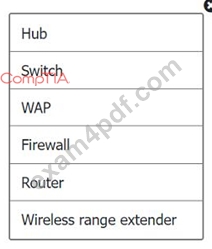
Select the appropriate network device for each location. If applicable, click on the magnifying glass next to any device which may require configuration updates and make any necessary changes.
Not all devices will be used, but all locations should be filled.
If at any time you would like to bring back the initial state of the simulation, please click the Reset All button.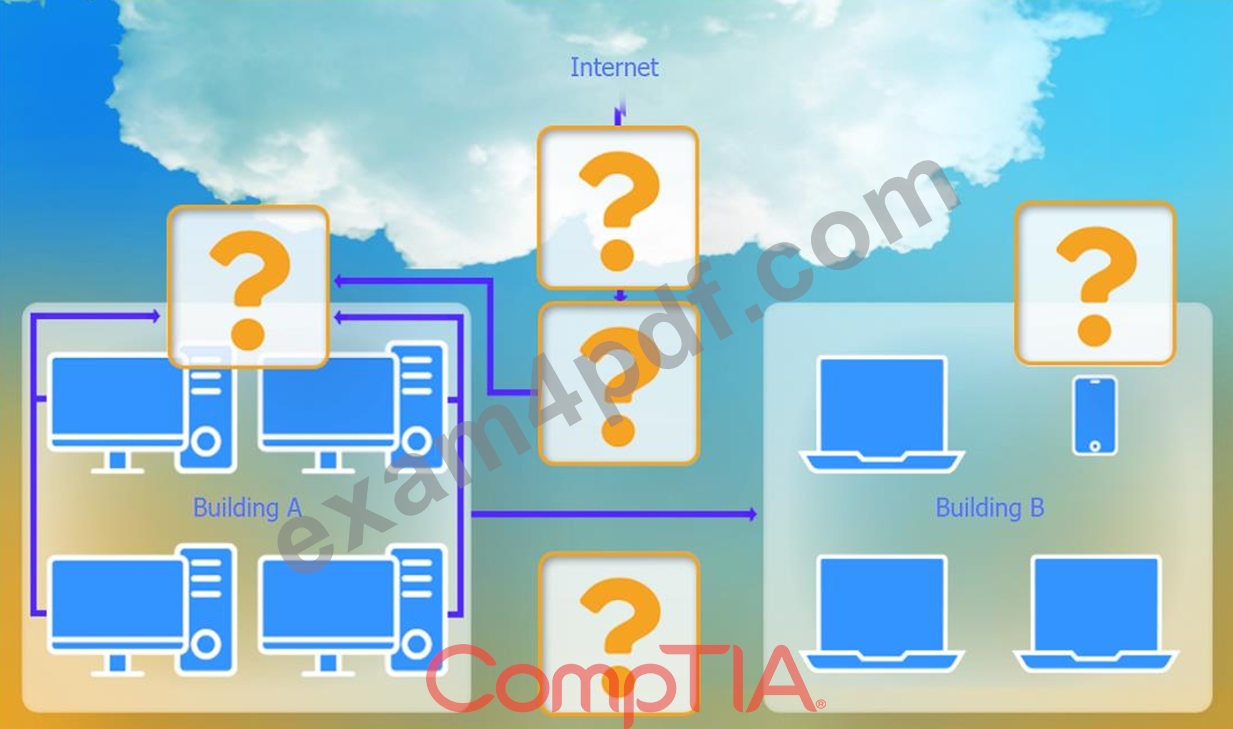
Answer:
Explanation:
See the answer and solution below
Explanation:
Devices in both buildings should be able to access the Internet.
Security insists that all Internet traffic be inspected before entering the network.
Desktops should not see traffic destined for other devices.
Here is the corrected layout with explanation:
Building A:
Switch: Correctly placed to connect all desktops.
Firewall: Correctly placed to inspect all incoming and outgoing traffic.
Building B:
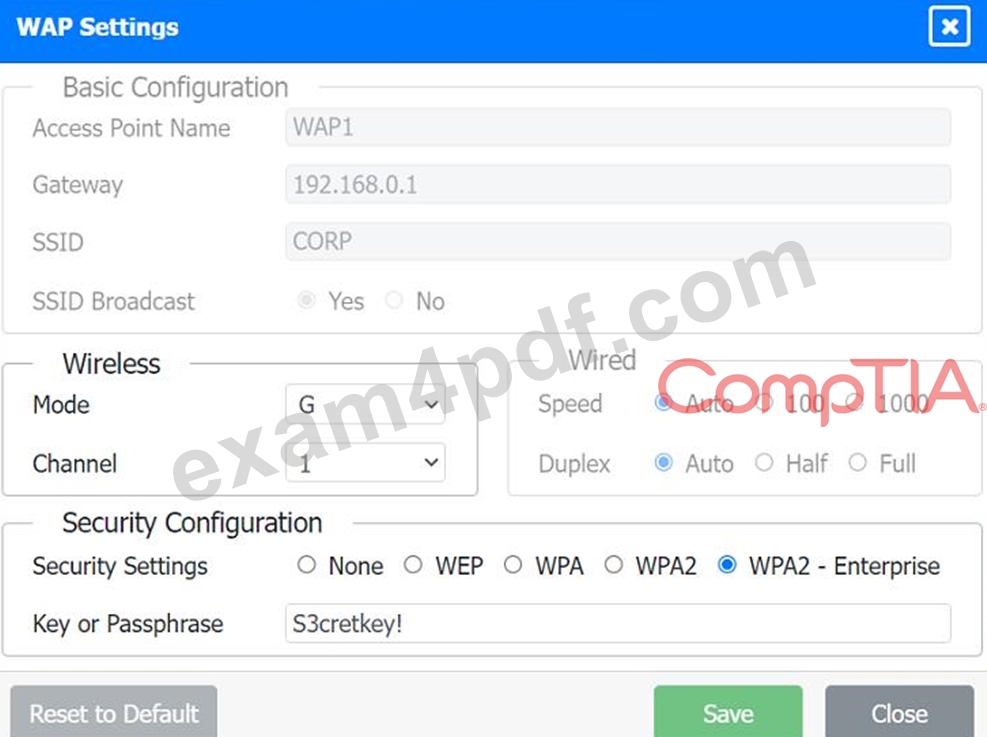
Switch: Not needed. Instead, place a Wireless Access Point (WAP) to provide wireless connectivity for laptops and mobile devices.
Between Buildings:
Wireless Range Extender: Correctly placed to provide connectivity between the buildings wirelessly.
Connection to the Internet:
Router: Correctly placed to connect to the Internet and route traffic between the buildings and the Internet.
Firewall: The firewall should be placed between the router and the internal network to inspect all traffic before it enters the network.
Corrected Setup:
Top-left (Building A): Switch
Bottom-left (Building A): Firewall (inspect traffic before it enters the network) Top-middle (Internet connection): Router Bottom-middle (between buildings): Wireless Range Extender Top-right (Building B): Wireless Access Point (WAP) In this corrected setup, the WAP in Building B will connect wirelessly to the Wireless Range Extender, which is connected to the Router. The Router is connected to the Firewall to ensure all traffic is inspected before it enters the network.
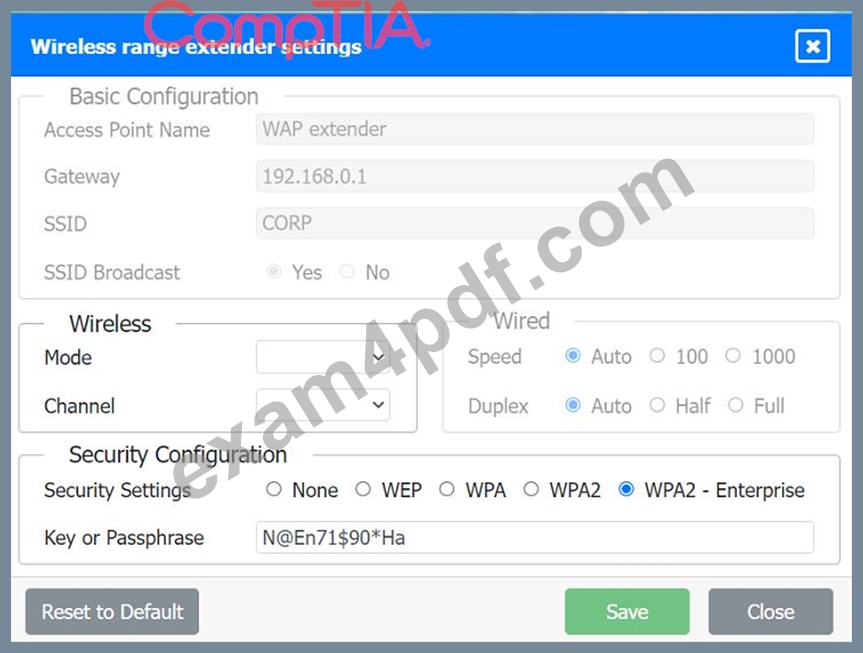
Configuration for Wireless Range Extender:
SSID: CORP
Security Settings: WPA2 or WPA2 - Enterprise
Key or Passphrase: [Enter a strong passphrase]
Mode: [Set based on your network plan]
Channel: [Set based on your network plan]
Speed: Auto
Duplex: Auto
With these settings, both buildings will have secure access to the Internet, and all traffic will be inspected by the firewall before entering the network. Desktops and other devices will not see traffic intended for others, maintaining the required security and privacy.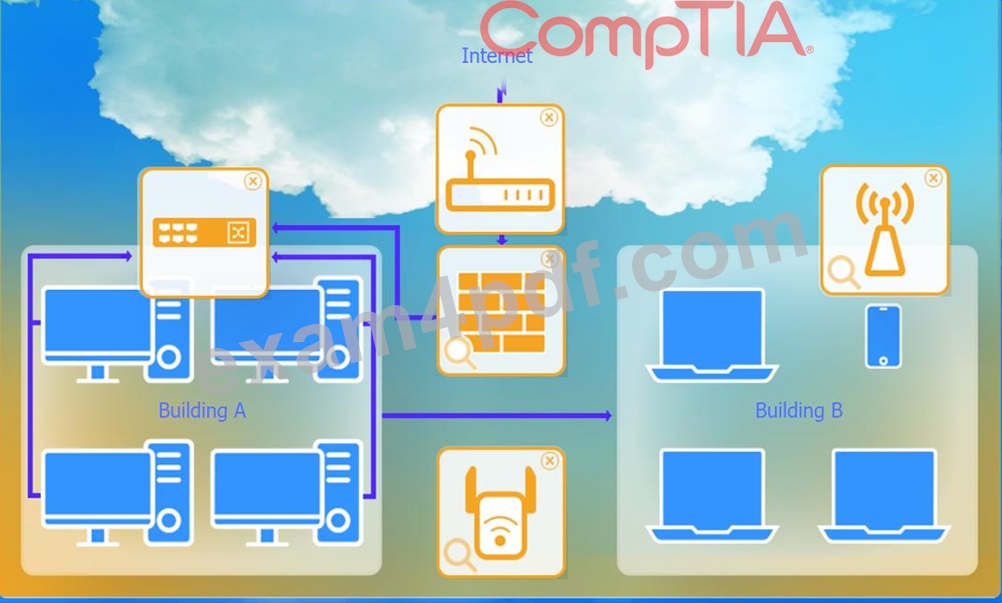
To configure the wireless range extender for security, follow these steps:
SSID (Service Set Identifier):
Ensure the SSID is set to "CORP" as shown in the exhibit.
Security Settings:
WPA2 or WPA2 - Enterprise: Choose one of these options for stronger security. WPA2-Enterprise provides more robust security with centralized authentication, which is ideal for a corporate environment.
Key or Passphrase:
If you select WPA2, enter a strong passphrase in the "Key or Passphrase" field.
If you select WPA2 - Enterprise, you will need to configure additional settings for authentication servers, such as RADIUS, which is not shown in the exhibit.
Wireless Mode and Channel:
Set the appropriate mode and channel based on your network design and the environment to avoid interference. These settings are not specified in the exhibit, so set them according to your network plan.
Wired Speed and Duplex:
Set the speed to "Auto" unless you have specific requirements for 100 or 1000 Mbps.
Set the duplex to "Auto" unless you need to specify half or full duplex based on your network equipment.
Save Configuration:
After making the necessary changes, click the "Save" button to apply the settings.
Here is how the configuration should look after adjustments:
SSID: CORP
Security Settings: WPA2 or WPA2 - Enterprise
Key or Passphrase: [Enter a strong passphrase]
Mode: [Set based on your network plan]
Channel: [Set based on your network plan]
Speed: Auto
Duplex: Auto
Once these settings are configured, your wireless range extender will provide secure connectivity for devices in both buildings.
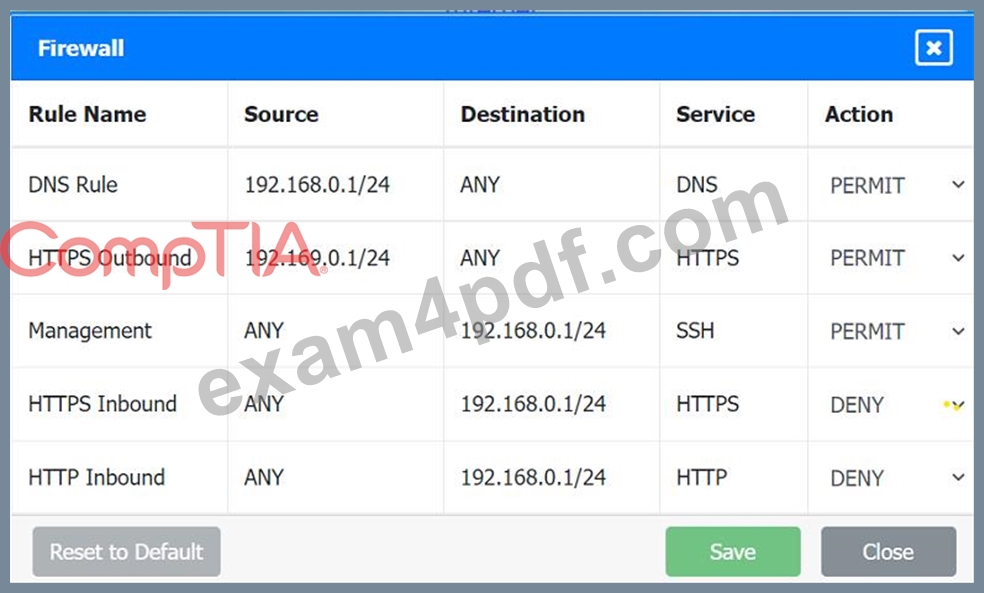
Firewall setting to to ensure complete compliance with the requirements and best security practices, consider the following adjustments and additions:
DNS Rule: This rule allows DNS traffic from the internal network to any destination, which is fine.
HTTPS Outbound: This rule allows HTTPS traffic from the internal network (assuming 192.169.0.1/24 is a typo and should be 192.168.0.1/24) to any destination, which is also good for secure web browsing.
Management: This rule allows SSH access to the firewall for management purposes, which is necessary for administrative tasks.
HTTPS Inbound: This rule denies inbound HTTPS traffic to the internal network, which is good unless you have a web server that needs to be accessible from the internet.
HTTP Inbound: This rule denies inbound HTTP traffic to the internal network, which is correct for security purposes.
Suggested Additional Settings:
Permit General Outbound Traffic: Allow general outbound traffic for web access, email, etc.
Block All Other Traffic: Ensure that all other traffic is blocked to prevent unauthorized access.
Firewall Configuration Adjustments:
Correct the Network Typo:
Ensure that the subnet 192.169.0.1/24 is corrected to 192.168.0.1/24.
Permit General Outbound Traffic:
Rule Name: General Outbound
Source: 192.168.0.1/24
Destination: ANY
Service: ANY
Action: PERMIT
Deny All Other Traffic:
Rule Name: Block All
Source: ANY
Destination: ANY
Service: ANY
Action: DENY
Here is how your updated firewall settings should look:
Rule Name
Source
Destination
Service
Action
DNS Rule
192.168.0.1/24
ANY
DNS
PERMIT
HTTPS Outbound
192.168.0.1/24
ANY
HTTPS
PERMIT
Management
ANY
192.168.0.1/24
SSH
PERMIT
HTTPS Inbound
ANY
192.168.0.1/24
HTTPS
DENY
HTTP Inbound
ANY
192.168.0.1/24
HTTP
DENY
General Outbound
192.168.0.1/24
ANY
ANY
PERMIT
Block All
ANY
ANY
ANY
DENY
These settings ensure that:
Internal devices can access DNS and HTTPS services externally.
Management access via SSH is permitted.
Inbound HTTP and HTTPS traffic is denied unless otherwise specified.
General outbound traffic is allowed.
All other traffic is blocked by default, ensuring a secure environment.
Make sure to save the settings after making these adjustments.
NEW QUESTION # 115
......
Achieve Success in Actual N10-009 Exam N10-009 Exam Dumps: https://dumpstorrent.exam4pdf.com/N10-009-dumps-torrent.html
